
 Old Kitchen Stories
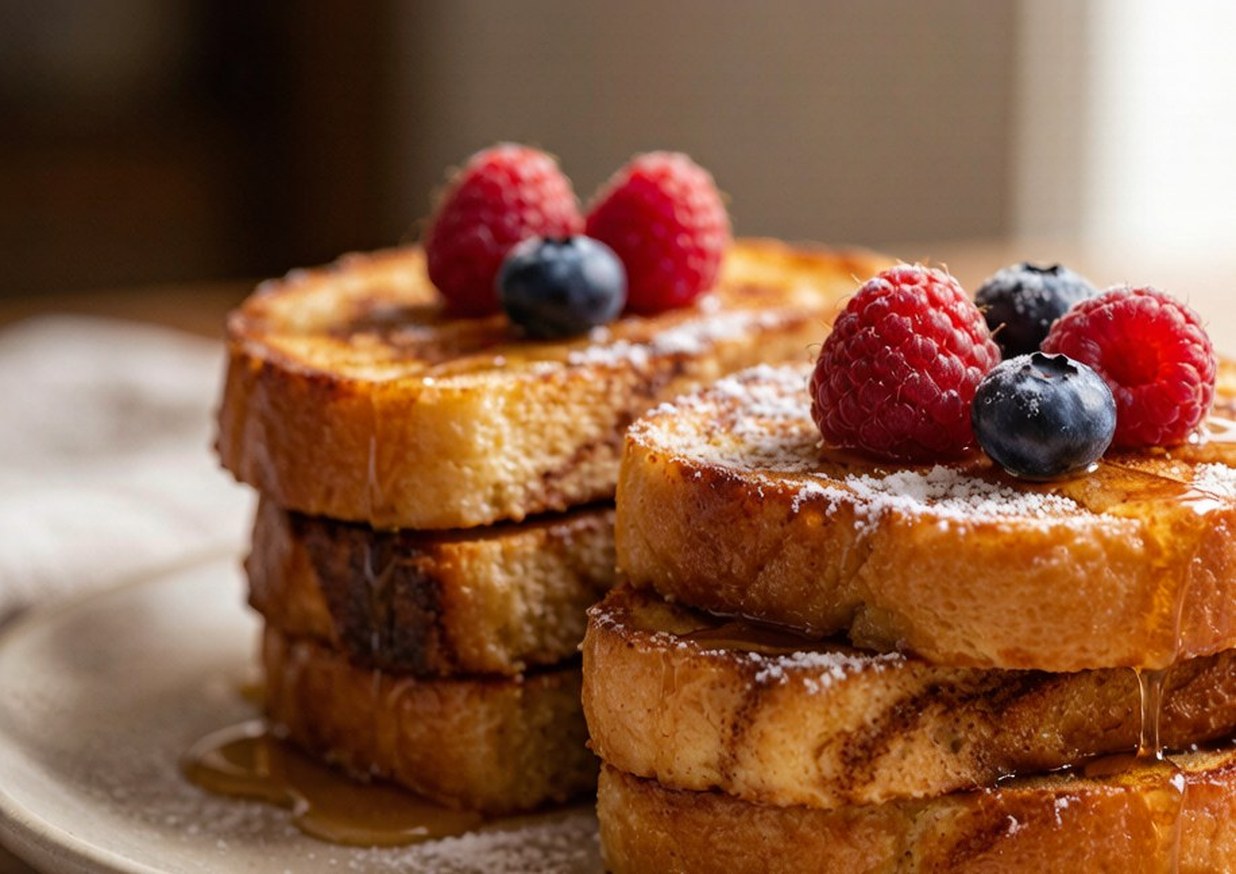
Quick answer: Whisk 3 eggs with 3/4 cup whole milk, 1/4 cup cream, 2 tbsp sugar, 1 1/2 tsp cinnamon, 1/4 tsp nutmeg, and 1 tsp vanilla. Soak 8 slices of two-day-old brioche, cut 2.5 cm thick, for 2 minutes a side. Griddle in butter over medium-low heat for 3 to 4 minutes a side until deep golden, then serve hot.
- Prep time: 10 minutes
- Cook time: 15 minutes
- Total time: 25 minutes
- Servings: 4
- Cuisine: American
- Course: Breakfast & Brunch
- Difficulty: Easy
Why this recipe works
French toast goes wrong when the bread and the custard are out of balance. Fresh sandwich bread is too soft: it tears the moment it is saturated, and it cannot hold enough custard to taste like anything. Stale brioche, cut thick, has the structure to absorb a full custard without collapsing, and its butter and sugar content means the surface caramelises properly. The second decision is the ratio. Roughly one egg per two thick slices gives you a custard that sets in the middle rather than scrambling on the outside. Finally, the heat has to be low enough that the centre is cooked by the time the crust is dark; medium-low and 3 to 4 minutes a side. The custard ratio follows the baking guidance at King Arthur, scaled for a home griddle.
Our method follows the technique guidance published by King Arthur Baking Company — Baking Resources and is adapted for a standard home kitchen.
Ingredients
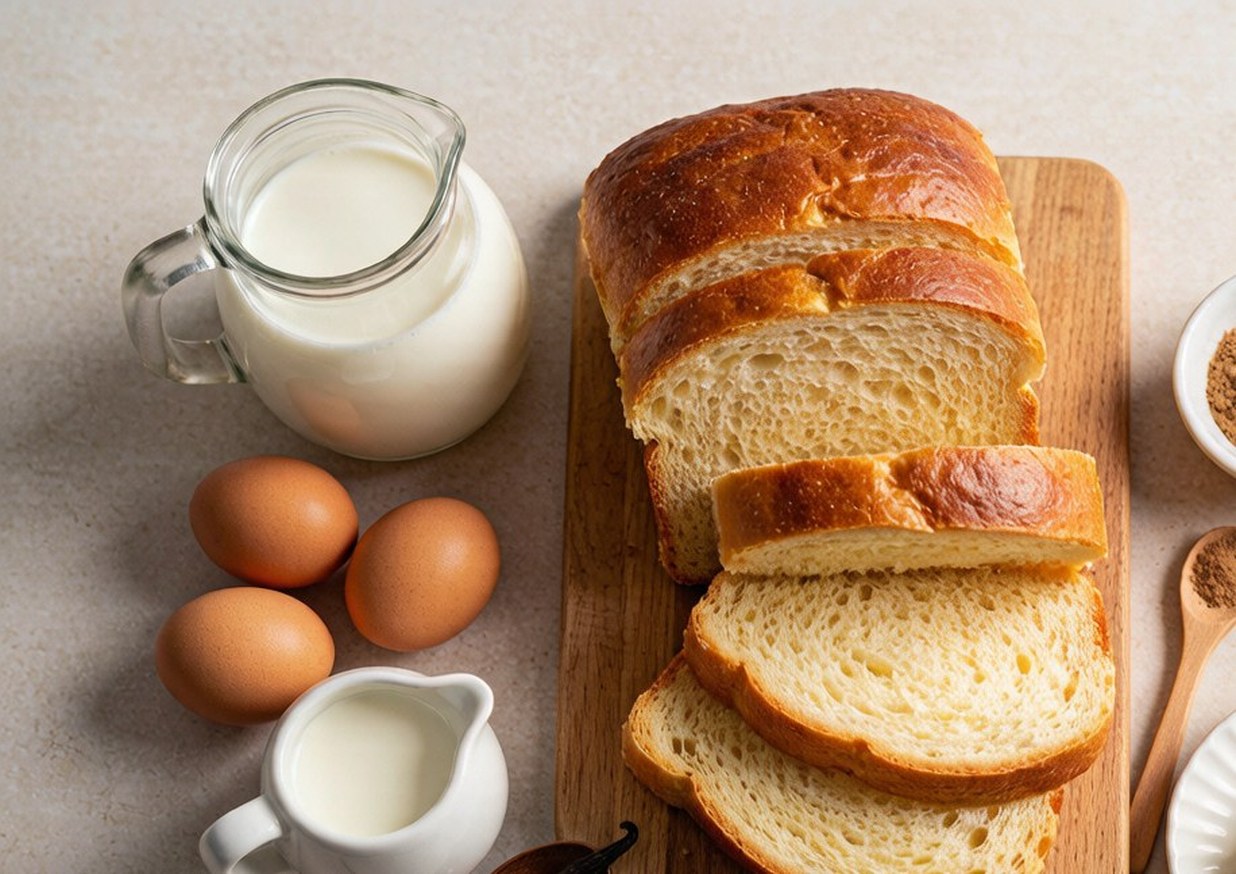
- 8 slices brioche or challah, cut 2.5 cm thick, ideally two days old
- 3 large eggs
- 3/4 cup / 180 ml whole milk
- 1/4 cup / 60 ml heavy cream
- 2 tbsp granulated sugar
- 1 1/2 tsp ground cinnamon
- 1/4 tsp freshly grated nutmeg
- 1 tsp vanilla extract
- Pinch of fine sea salt
- 3 tbsp unsalted butter, for the pan
- Maple syrup, icing sugar, or fresh berries, for serving
Equipment
- A wide shallow dish — a 23 x 33 cm baking dish is ideal for soaking without stacking
- A flat griddle or large cast-iron skillet
- A whisk and a jug for the custard
- A thin flexible spatula wide enough to support a whole slice
- A wire rack in a warm oven, for holding finished slices without steaming them
How to make french toast step by step
- Dry the bread. If your brioche is fresh rather than stale, lay the slices on a rack and leave them out for at least an hour, or bake them at 120°C / 250°F for 12 minutes. Drier bread absorbs more custard.
- Make the custard. Whisk the eggs, milk, cream, sugar, cinnamon, nutmeg, vanilla, and salt in a jug until completely smooth, with no streaks of egg white.
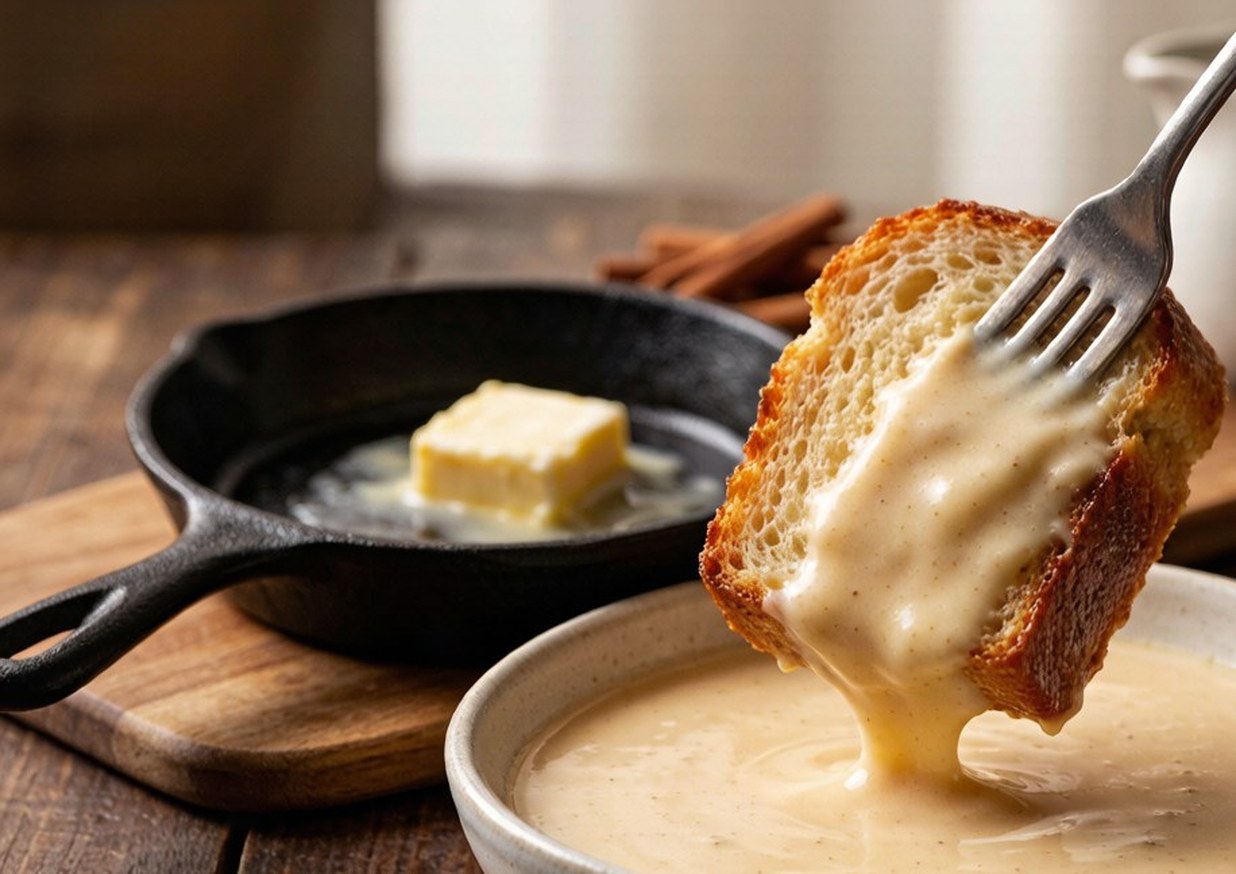
- Soak. Pour the custard into the shallow dish. Lay the slices in a single layer and soak for 2 minutes, then turn and soak for another 2 minutes. Thick slices can take 3 minutes a side.
- Heat the pan. Set the griddle over medium-low heat and add 1 tbsp of butter. It should foam gently, not brown immediately. If it browns, the pan is too hot.
- Griddle. Lift each slice, letting the excess custard drip off, and lay it in the pan. Cook 3 to 4 minutes until deep golden, then flip and cook 3 minutes more. The slice should feel springy, not wet, when you press the centre.
- Adjust the heat. Lower the heat for the second batch; the pan will have come up to temperature and butter solids darken fast.
- Hold and serve. Keep the cooked slices on a rack in a 95°C / 200°F oven. Serve hot with maple syrup, a dusting of icing sugar, or berries.
What we learned testing this french toast recipe
We cooked this recipe three times before publishing it. These are the things that only showed up in the kitchen, not on paper.
- Fresh brioche versus two-day-old brioche was the clearest test we ran. The fresh slices tore when lifted and could not hold enough custard, so the middle stayed bready. Stale slices soaked up nearly twice the custard and held together.
- We tried a 1.5 cm slice and a 2.5 cm slice side by side. The thin slice cooked through before the outside caramelised and came out limp; the thick slice had a properly set custard centre and a crisp crust.
- One batch was cooked on too high a heat. The outside went nearly black while the centre was still liquid, and the burnt milk solids tasted bitter. Medium-low and four minutes a side is the reliable setting.
- We tested soaking for five minutes instead of two. The slices became so saturated they fell apart on the way to the pan, and the finished toast was wet in the middle even after extended cooking.
- Wiping the pan between batches was the fix for a problem we could not initially identify: butter solids from batch one were darkening and turning batch two bitter.
Expert tips
- Press the centre of a slice with your finger. If it feels wet or squishes, it needs another minute; the outside colour is not a reliable guide.
- Wipe the pan between batches and add fresh butter. Burnt milk solids will turn the next batch bitter.
- Grind your own cinnamon if you can. Pre-ground loses most of its aroma within a year, and this dish is almost entirely about that aroma.
- Cut the bread yourself rather than buying pre-sliced. Thickness is the single biggest variable in the finished texture.
Variations and substitutions
- Stuffed: cut a pocket in each slice and fill it with cream cheese and raspberry jam before soaking, as in the French toast commonly served at American diners.
- Orange and cardamom: add the zest of one orange and 1/4 tsp ground cardamom to the custard and drop the nutmeg.
- Baked for a crowd: arrange soaked slices in a buttered dish and bake at 190°C / 375°F for 20 minutes, turning once.
- Savoury: leave out the sugar, cinnamon, and vanilla, and add black pepper and a handful of grated Gruyere.
Troubleshooting
| What went wrong | Why it happens | How to fix it |
|---|---|---|
| Soggy in the middle | Heat too high, so the crust set before the custard cooked. | Drop to medium-low and cook 3 to 4 minutes a side; press the centre to check it feels springy, not wet. |
| Bread fell apart when soaking | The bread was too fresh or soaked too long. | Use brioche at least a day old, cut 2.5 cm thick, and cap the soak at 2 minutes a side. |
| Eggy, custard-like pockets | The custard was not whisked smooth, or there was too much egg for the bread. | Whisk until completely smooth with no streaks of white, and use one egg per two to three thick slices. |
| Burnt outside, bitter taste | Butter solids scorched from cooking too hot or not wiping the pan. | Medium-low heat, fresh butter for each batch, and wipe the pan with a paper towel between batches. |
Storage, food safety and make-ahead
Cooked French toast keeps for 2 days in the fridge and reheats well in a toaster or a 190°C / 375°F oven for 6 minutes. Freeze in a single layer for up to 1 month. The custard can be mixed a day ahead and kept covered in the fridge; whisk it again before using.
For safe cooling, storage times, and reheating, follow the USDA FSIS food safety guidance.
Nutrition information
Per serving of 2 slices, without syrup: approximately 465 kcal, 16 g protein, 26 g fat, 43 g carbohydrates, 2 g fibre, 540 mg sodium. Values are estimates derived from USDA FoodData Central and will vary with brands and portion size.
Figures are calculated from the USDA FoodData Central database and are estimates only. Values vary with ingredient brands and portion size.
Frequently asked questions
Why is my French toast soggy in the middle?
The heat was too high, so the outside set before the custard inside could cook, or the slices were soaked too long and became saturated. Use medium-low and cap the soak at 2 minutes a side for a 2.5 cm slice.
Can I make it without cream?
Yes. Use 1 cup of whole milk in place of the milk and cream. The result is slightly less rich but still custardy; skim milk, however, gives a noticeably watery interior.
What is the best bread?
Brioche or challah, two days old if possible. Sourdough works but its tang competes with the cinnamon. Standard sandwich bread is too thin and tears when soaked.
Can I make it dairy-free?
Yes, with a neutral oat or soy milk and a dairy-free spread for the pan. Coconut milk works for richness but its flavour comes through strongly.
Sources and further reading
- USDA FoodData Central
- King Arthur Baking Company — Baking Resources
- Serious Eats — The Food Lab
- Epicurious — Recipe Archive & Technique Guides
Nutrition figures on this page are calculated from the USDA FoodData Central database and are estimates only. They are not a substitute for advice from a qualified dietitian or physician.
Last updated: September 7, 2026. Recipe tested three times in a standard home kitchen by the named author above. Corrections are welcome and are noted on the page when published.