
 Old Kitchen Stories
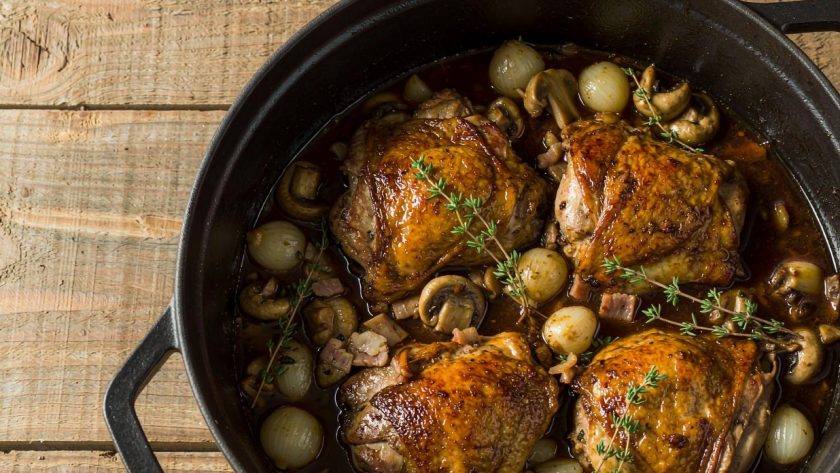
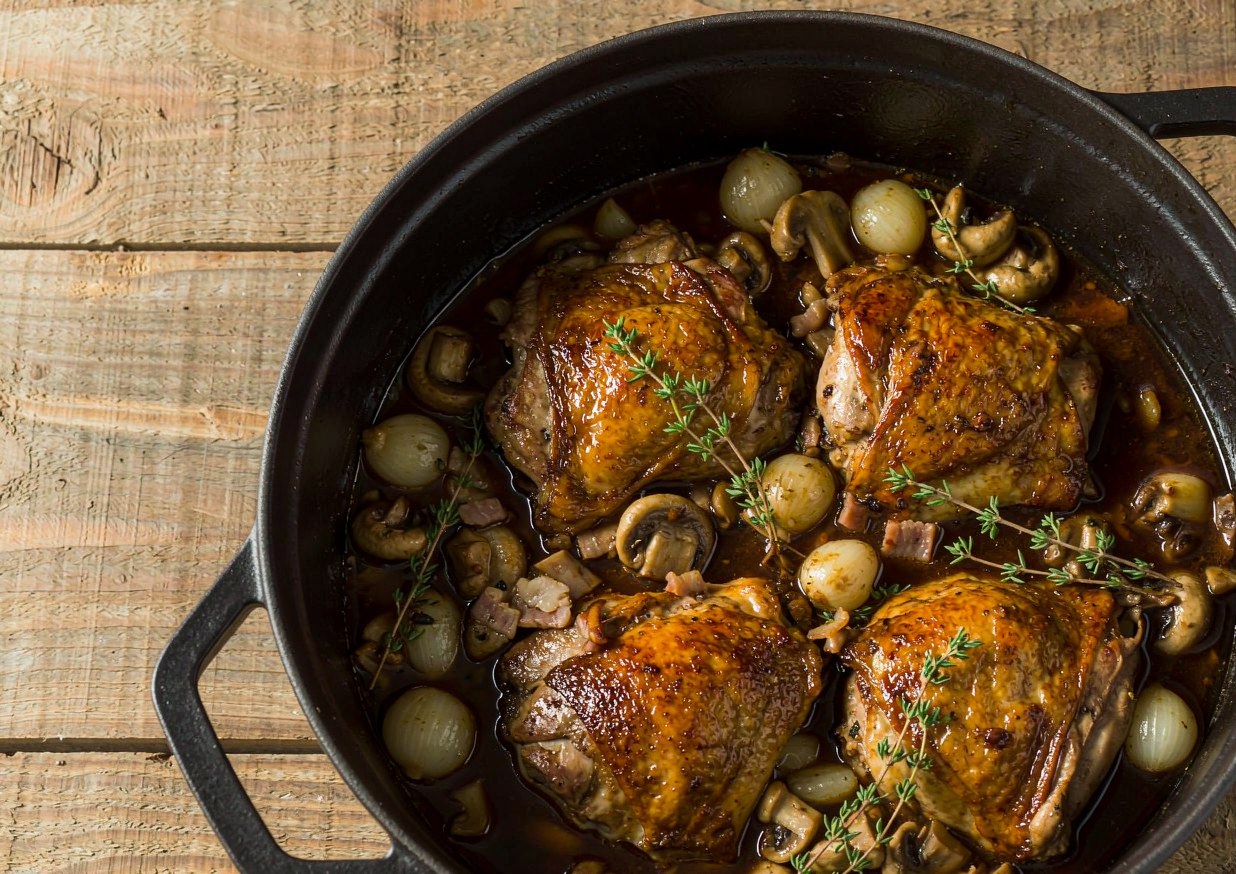
Quick answer: Coq au vin is chicken browned in rendered lardons and braised with mushrooms and pearl onions in red wine and stock until the sauce is glossy enough to coat a spoon. Dry 1.4 kg of bone-in chicken pieces thoroughly and season them. Render 150 g of lardons in a casserole until crisp, lift them out, and brown the chicken in the fat in two batches, skin side down, for 6 to 8 minutes. Soften 2 sliced onions, 2 carrots and 2 celery sticks in the same pot, add garlic, tomato paste and 250 g of mushrooms, then pour in 400 ml of red wine and 400 ml of stock with a bouquet garni. Sit the chicken back on top skin side up, cover, and braise at 170°C / 340°F for 40 minutes, then uncovered for 15. Whisk in a beurre manié to thicken, and finish with the lardons and parsley.
- Prep time: 30 minutes
- Cook time: 55 minutes
- Total time: 85 minutes
- Servings: 6
- Cuisine: French
- Course: Soups & Stews
- Difficulty: Medium
Why this recipe works
Two things make this taste of a French kitchen rather than of stewed chicken, and both happen before any liquid goes in. First the lardons: rendering 150 g of them slowly gives you the fat to brown in and a spoonful of smoky bits to finish with, and the fond they leave behind is most of the sauce’s depth. Second, browning: the chicken has to be dry and left alone, skin side down, until it releases on its own. The wine is not there to make it boozy — its acid and tannin cut the fat, and reducing it by a third before the lid goes on concentrates that. Then the braise is gentle: a tight lid and a low oven poach the meat while collagen turns to gelatin, which is what gives the sauce body. The uncovered last quarter reduces and glazes, and the beurre manié is what turns a thin broth into a sauce that clings.
Our method follows the technique guidance published by BBC Food — Recipes & Techniques and is adapted for a standard home kitchen.
Ingredients
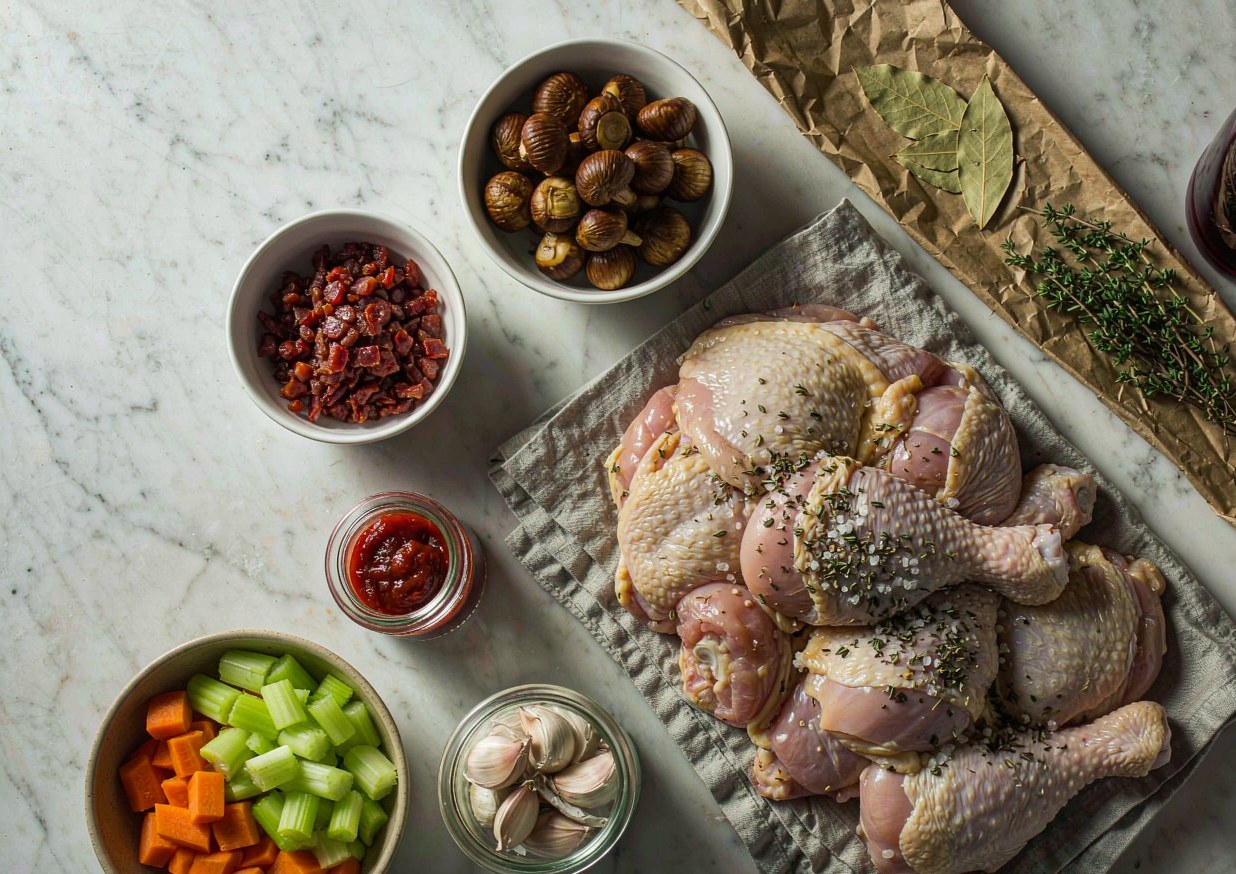
- 1.4 kg / 3 lb bone-in, skin-on chicken thighs and drumsticks, about 6 pieces
- 150 g / 5 oz smoked lardons, or thick-cut streaky bacon cut into 1 cm batons
- 2 medium onions, halved and sliced
- 2 carrots, peeled and cut into 1 cm coins
- 2 celery sticks, sliced
- 250 g / 9 oz chestnut mushrooms, halved, or quartered if large
- 200 g / 7 oz pearl onions, peeled — frozen ones are fine and far less work
- 3 garlic cloves, crushed, and 2 tbsp tomato paste
- 400 ml / 1 2/3 cups dry red wine; for an alcohol-free version use the same volume of chicken stock plus 1 tbsp red wine vinegar
- 400 ml / 1 2/3 cups chicken stock, plus a splash more if the sauce tightens too far
- A bouquet garni: 4 thyme sprigs, 2 bay leaves and a few parsley stalks, tied together
- Beurre manié: 25 g / 2 tbsp soft butter mashed to a paste with 25 g / 3 tbsp plain flour
- 2 tbsp chopped flat-leaf parsley, and fine sea salt and black pepper
Equipment
- A 26 cm cast-iron casserole or enameled Dutch oven with a tight lid, which goes from the hob into a 170°C oven
- An instant-read thermometer, to confirm the thickest thigh has reached 74°C / 165°F
- Kitchen tongs for turning the chicken, and a spider or slotted spoon for lifting out
- A digital kitchen scale and a measuring jug — the wine-to-stock ratio sets the sauce
- A small whisk for the beurre manié, and butcher’s twine for the bouquet garni
- Paper towels: the chicken has to be dry before it goes near the fat
How to make coq au vin step by step
- Dry the chicken and season it. Pat every piece dry with paper towels until the skin feels tacky — water on the surface steams instead of browning. Salt and pepper it generously on all sides and leave it on a plate while you start the lardons.
- Render the lardons. Put them in the cold casserole over medium-low heat for 8 to 10 minutes, stirring now and then, until the fat has run out and the bits are crisp. Lift them out onto a plate and leave the fat behind, keeping about 2 tablespoons of it.
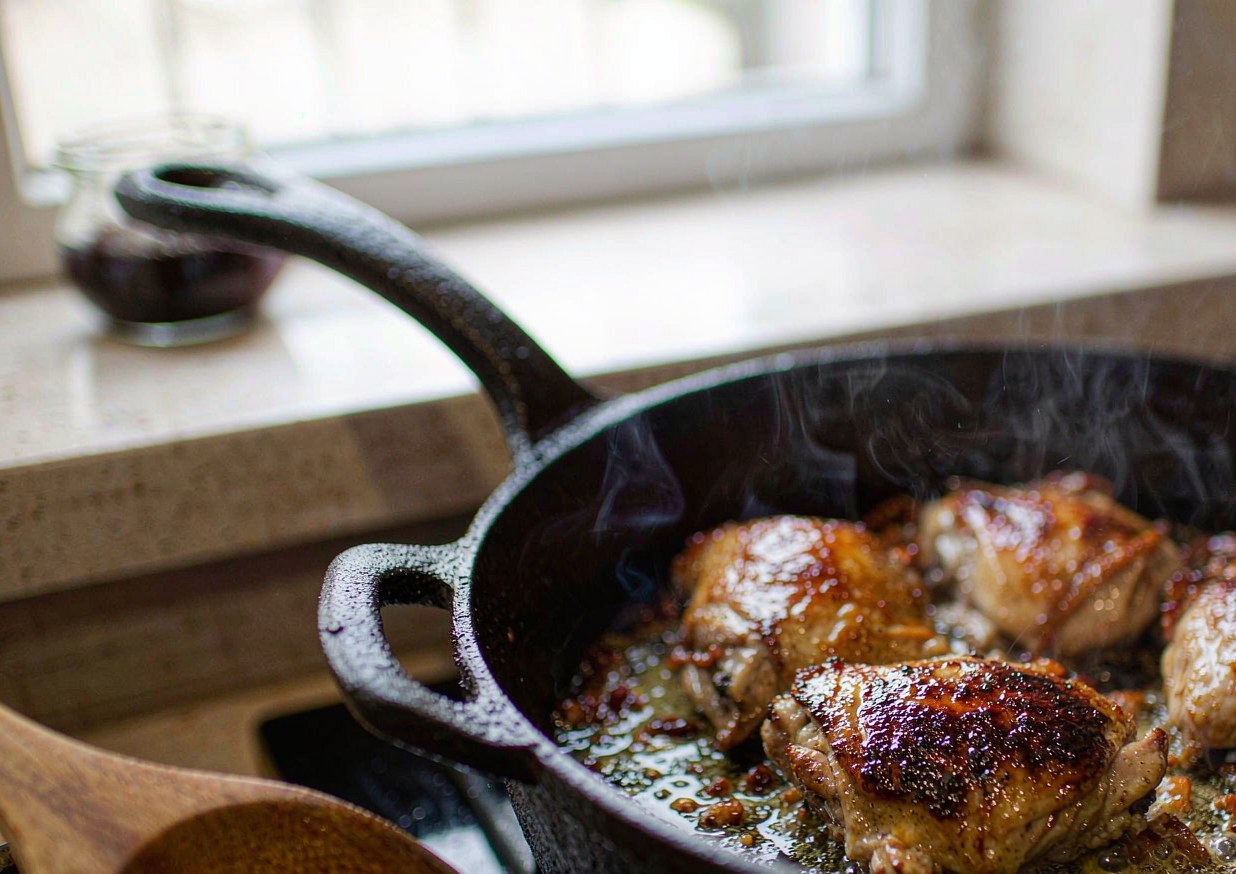
- Brown the chicken in two batches. Raise the heat to medium-high. Lay in half the pieces skin side down and leave them completely alone for 6 to 8 minutes, until the skin is deep brown and lets go of the pan without tearing. Turn, give the second side 3 minutes, and move to a plate. Repeat with the rest.
- Build the base. Drop the heat to medium and put in the onions, carrots and celery with a pinch of salt. Cook 8 minutes, scraping at the brown bits as they soften, until the edges are gold. Add the garlic and the tomato paste and cook 2 minutes more, until the paste darkens to brick red.
- Deglaze with the wine. Pour in the wine, bring it to a simmer, and scrape the base of the pot clean. Let it bubble for 6 to 8 minutes, until it has reduced by roughly a third and no longer smells sharp. Add the stock, the mushrooms, the pearl onions and the bouquet garni.
- Braise covered. Sit the chicken back on top, skin side up, with any juice from the plate. The liquid should come about two-thirds up the meat, not cover it. Bring it to a bare simmer, put the lid on, and slide it into a 170°C / 340°F oven for 40 minutes.
- Finish uncovered. Take the lid off and give it another 12 to 15 minutes, until the skin has glazed and the liquid has dropped by about a third. Check with the thermometer: the thickest thigh should read 74°C / 165°F. Lift the chicken onto a warm dish and fish out the bouquet garni.
- Thicken and serve. Skim the fat off the surface. Bring the sauce to a simmer and whisk in the beurre manié in small pieces until it thickens and turns glossy; simmer 2 minutes to cook out the flour. Season, spoon the sauce back over the chicken, and scatter with the lardons and parsley.
What we learned testing this coq au vin recipe
We cooked this recipe three times before publishing it. These are the things that only showed up in the kitchen, not on paper.
- Our first pot was a genuine failure. We used boneless, skinless breast because that is what was in the fridge, crowded all six pieces into the pan at once, and poured the wine in without reducing it. The chicken never browned — it poached grey in its own liquid — and by the time the sauce had reduced enough to taste of anything the breast had gone stringy. Skin-on thighs and drumsticks, browned in two batches with the wine reduced by a third first, turned the same ingredients into the dish we wanted.
- Wine reduction, three pots from one batch of ingredients: straight in with the stock gave a sauce that still tasted raw and sharp after 40 minutes under the lid; 4 minutes took the edge off; 8 minutes, down by a third, gave a round, glossy sauce. Eight minutes is the number.
- Browning, six pieces at once against two batches of three: the crowded pan dropped below sizzling, the skin stuck and tore, and the fond was patchy. Two batches gave deep brown skin in 7 minutes and caramelised bits that did most of the work.
- Oven against hob, one recipe split in two: the oven at 170°C / 340°F braised evenly to 76°C / 169°F with the skin intact on top; the hob needed stirring twice to stop the bottom catching, and the exposed pieces dried out. We kept the oven.
- Thickener, tried three: a beurre manié whisked in at a simmer gave a glossy sauce with no raw flour taste after 2 minutes; a flour-and-water slurry worked but dulled the shine; cornflour went translucent and thinned again on reheating.
Expert tips
- Bone-in, skin-on thighs and drumsticks, not breast. Breast is cooked through long before the sauce has reduced and dries out every time.
- Brown in batches and do not move the pieces. A crowded pan drops below browning temperature, and turning too early tears the skin off.
- Skim before you thicken. A beurre manié beaten into a fatty sauce gives a greasy, dull one.
Variations and substitutions
- Coq au vin blanc: swap the red for a dry Riesling or a light white and drop the tomato paste; the sauce comes out paler and sharper.
- Coq au chambertin: the Burgundy version, with the onions and mushrooms browned separately in butter first.
- Alcohol-free: replace the wine with 400 ml of stock plus 1 tbsp of red wine vinegar, and add 1 tsp of tomato paste for colour.
- With mustard: stir 1 tbsp of Dijon into the sauce with the beurre manié.
Troubleshooting
| What went wrong | Why it happens | How to fix it |
|---|---|---|
| Sauce is thin, watery or tastes sharply of wine | The wine went in with the stock and was never reduced, so the raw acid is still in the pot and there is too much liquid. | Simmer the wine hard for 6 to 8 minutes until it has dropped by a third before the stock goes in, and finish uncovered for the last 12 to 15 minutes. |
| Chicken skin is pale, flabby or came off in the pan | The pieces were wet when they went in, or the pan was crowded, so they steamed rather than browned and stuck. | Pat the chicken dry until the skin feels tacky, brown it skin side down in two batches over medium-high heat, and leave it alone until it releases on its own. |
| Sauce is greasy, dull or looks split | The fat from the lardons and the skin was never skimmed, and the thickener went into it. | Skim the surface with a spoon, then whisk the beurre manié in small pieces at a bare simmer. If it has split, whisk in a tablespoon of cold stock off the heat. |
| Meat is dry or stringy | The cut was wrong, or the braise ran too hot. Breast has too little collagen to survive a 55-minute braise. | Use bone-in, skin-on thighs and drumsticks, keep the oven at 170°C / 340°F, and pull it when the thickest thigh reads 74°C / 165°F. |
Storage, food safety and make-ahead
Cool leftovers quickly in a shallow container, refrigerate for up to 3 days, and reheat in a covered pan over low heat with a splash of stock — a flour-thickened sauce splits if it is boiled. It is better on the second day: the sauce sets to a jelly and the meat takes up more of it. It freezes for up to 3 months, though the mushrooms soften on thawing. Reheat from frozen over low heat.
For safe cooling, storage times, and reheating, follow the USDA FSIS food safety guidance.
Nutrition information
Per serving (one of six): approximately 520 kcal, 38 g protein, 32 g fat, 12 g carbohydrates, 2 g fibre, 780 mg sodium. Values are estimates derived from the USDA FoodData Central database and will move with the cut of chicken and how much fat you skim.
Figures are calculated from the USDA FoodData Central database and are estimates only. Values vary with ingredient brands and portion size.
Frequently asked questions
Do I have to use a whole bottle of wine?
No. Four hundred millilitres is enough, and more than that tips the sauce sharp and thin. What matters is that it is reduced by a third before the lid goes on. For an alcohol-free version, use the same volume of stock with a tablespoon of red wine vinegar.
Can I make it on the hob instead of in the oven?
Yes. Keep the lid tight, hold the barest simmer — a bubble every second or two — and give it 45 minutes covered plus 15 uncovered. Stir once or twice to check the bottom is not catching; an oven braises more evenly.
Why is my sauce thin and watery?
Either it was not reduced far enough in the uncovered stage, or the beurre manié went in off the boil. Simmer it hard for 5 minutes first, then whisk the butter-and-flour paste in small pieces and let it bubble for 2 full minutes.
What should I serve it with?
Something that takes up sauce: boiled new potatoes, buttered egg noodles, mashed potato, or a plain baguette. A sharply dressed green salad afterwards cuts the richness.
Sources and further reading
- USDA FoodData Central
- BBC Food — Recipes & Techniques
- USDA FSIS — Safe Minimum Internal Temperatures
- Epicurious — Recipe Archive & Technique Guides
Nutrition figures on this page are calculated from the USDA FoodData Central database and are estimates only. They are not a substitute for advice from a qualified dietitian or physician.
Last updated: September 7, 2026. Recipe tested three times in a standard home kitchen by the named author above. Corrections are welcome and are noted on the page when published.