
 Old Kitchen Stories
Quick answer: Simmer 3 lb of peeled Yukon Gold potatoes in well-salted water until a knife slides through with no resistance, 20 to 25 minutes. Drain and steam dry for 2 minutes, then rice them straight into the warm pan. Fold in 6 tbsp softened butter, then 3/4 cup warm whole milk a splash at a time. Season with 1 1/2 tsp kosher salt and finish with chives.
- Prep time: 10 minutes
- Cook time: 30 minutes
- Total time: 40 minutes
- Servings: 6
- Cuisine: American
- Course: Sides & Salads
- Difficulty: Easy
Why this recipe works
Mashed potatoes fail in two opposite directions, and both come down to starch. Whip them hard in a food processor or beat them too long and the starch granules rupture, which turns the whole pan into wallpaper paste. Add cold milk and the starch seizes before it can absorb the fat, so you get a grey, thin mash. Our version avoids both: a ricer breaks the potatoes open without shearing the cells, warm milk keeps the fat liquid long enough to coat the starch, and everything is folded with a spatula rather than beaten. Yukon Gold is non-negotiable here. Russets are too dry and turn grainy; waxy new potatoes never fluff. This ratio follows the technique set out in the baking and technique library at King Arthur, adjusted for a home stove.
Our method follows the technique guidance published by King Arthur Baking Company — Baking Resources and is adapted for a standard home kitchen.
Ingredients
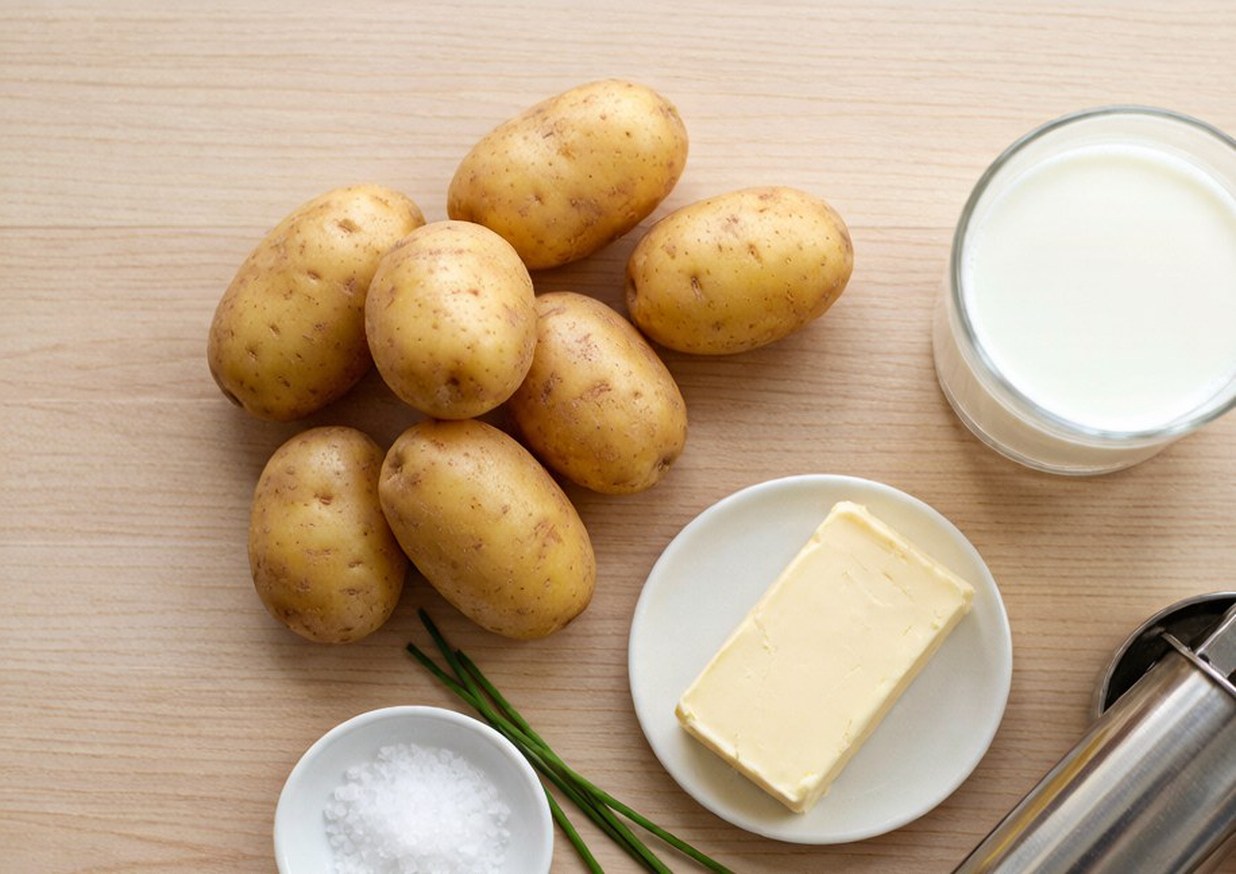
- 3 lb / 1.35 kg Yukon Gold potatoes, peeled and cut into 4 cm chunks
- 1 tbsp kosher salt, for the cooking water
- 6 tbsp / 85 g unsalted butter, softened, plus more for serving
- 3/4 cup / 180 ml whole milk, warmed
- 1 1/2 tsp kosher salt, plus more to taste
- 1/2 tsp white pepper (optional, keeps the colour clean)
- 2 tbsp snipped chives, for serving
- 1/4 cup / 60 ml sour cream or creme fraiche (optional, for extra richness)
Equipment
- A potato ricer or food mill — this is the one tool that changes the result; a box grater is the fallback and works almost as well
- A heavy saucepan with a lid, large enough that the potatoes are covered by 5 cm of water
- A handheld masher or silicone spatula for folding, never an electric mixer
- A small saucepan or microwave-safe jug for warming the milk
- A kitchen scale, if you want the skin-to-flesh ratio consistent between batches
How to make mashed potatoes step by step
- Cut evenly. Peel the potatoes and cut them into roughly equal 4 cm chunks. Uneven pieces mean the small ones disintegrate while the big ones are still firm.
- Start in cold water. Put the potatoes in the pan, cover with cold water by 5 cm, and add the tablespoon of salt. Starting cold cooks the outside and the inside at the same rate; dropping them into boiling water leaves the centres underdone.
- Simmer, do not boil. Bring to the boil, then drop to a steady simmer. Cook 20 to 25 minutes, until a paring knife meets no resistance in the centre of the largest chunk.
- Drain and steam dry. Drain well, then return the potatoes to the hot pan over the lowest heat for 2 minutes, shaking the pan. This drives off surface water that would otherwise thin the mash.
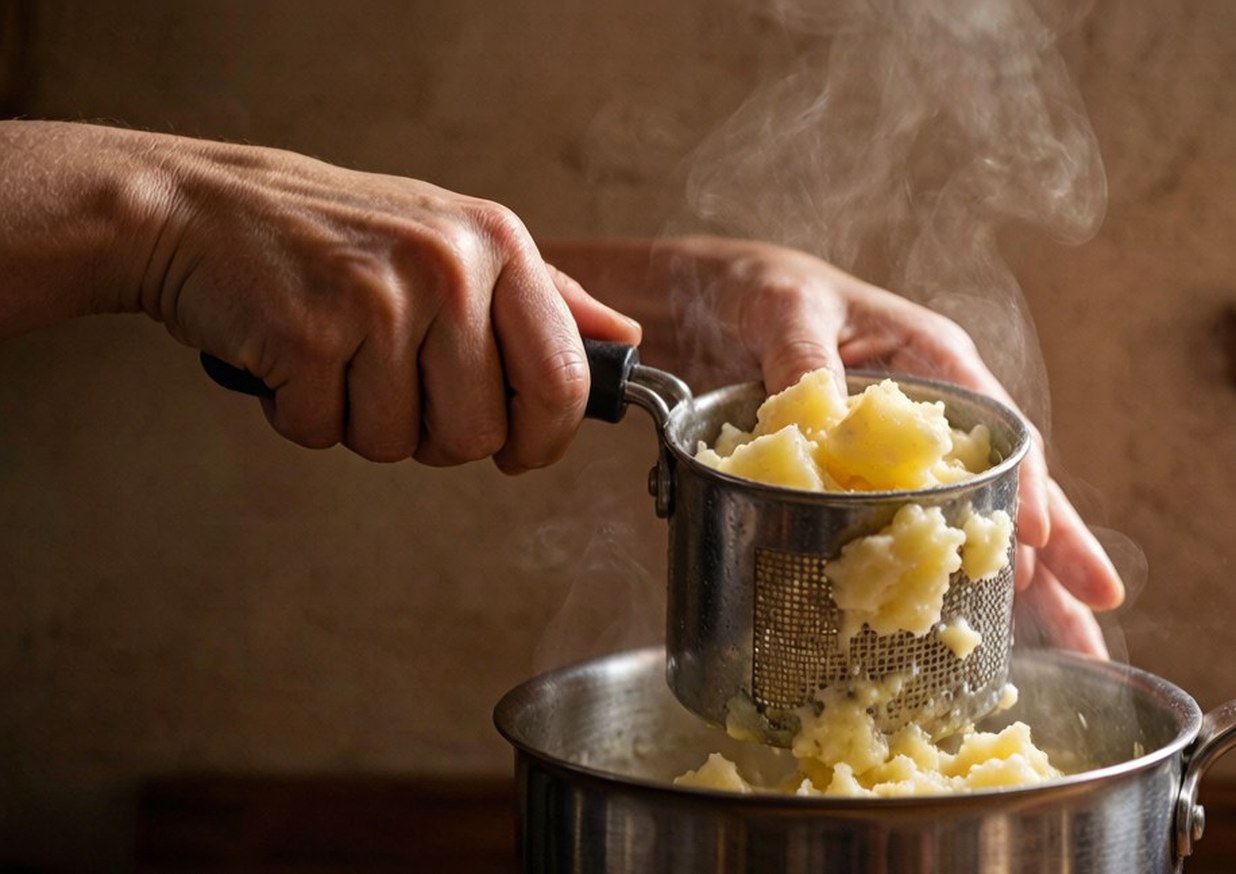
- Rice, do not mash. Press the hot potatoes through the ricer directly back into the warm pan. Work in batches. Do not press the ricer against the side of the pan you will serve from; the pressure matters.
- Butter first. Add the softened butter a third at a time, folding gently with a spatula. Fat coats the starch before the liquid arrives, which is what keeps the texture fluffy rather than gluey.
- Warm milk, gradually. Pour in the warm milk in three additions, folding each time before adding more. Stop when the mash mounds and slowly settles. You may not need all of it.
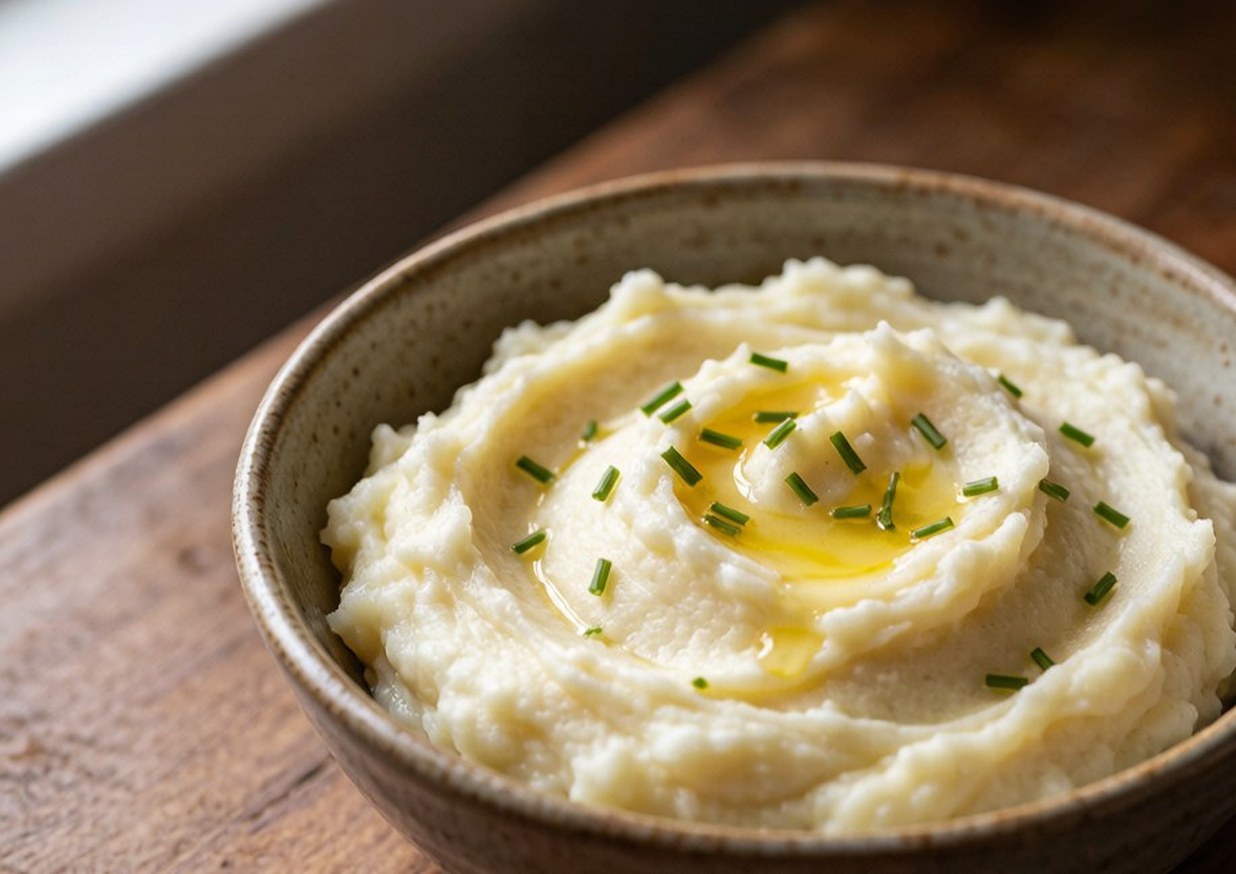
- Season and finish. Add the salt and white pepper, taste, and adjust. Fold through the sour cream if using. Serve with a well of melted butter and the chives.
What we learned testing this mashed potatoes recipe
We cooked this recipe three times before publishing it. These are the things that only showed up in the kitchen, not on paper.
- We ran a three-way potato test: russet, Yukon Gold, and a waxy new potato. Russet absorbed the most liquid but finished grainy, the waxy potato held its shape and stayed gluey, and Yukon Gold gave the fluffy-but-buttery result we wanted. It is the only variety we now use.
- The ricer beat every alternative. A handheld masher left small lumps no amount of folding removed, and a food processor turned the whole batch into a sticky paste within fifteen seconds. We threw that batch out.
- Cold milk was a visible failure. Straight from the fridge it dropped the temperature of the potatoes enough that the butter firmed up into small pale flecks, and the mash looked grey. Warming the milk first fixed it completely.
- We tested starting the potatoes in boiling water instead of cold. The outside of each chunk overcooked and started to break apart while the centre was still firm, and those broken pieces soaked up water and thinned the mash.
- Salting the cooking water properly, rather than seasoning only at the end, changed the result more than any other single step. Salted-at-the-end mash tasted seasoned on the surface and bland underneath.
Expert tips
- Warm the milk in the microwave or a small pan. Cold milk is the most common reason mash turns out dense and grey.
- Salt the cooking water properly. Potatoes absorb salt as they cook, and salt added only at the end tastes like it is sitting on the surface.
- If you are serving a crowd, hold the finished mash in a covered bowl set over a pan of barely simmering water for up to two hours.
- For a deeper flavour, warm the milk with a crushed garlic clove and a sprig of thyme, then discard both before folding it in.
Variations and substitutions
- Colcannon: fold in 2 cups of blanched, chopped kale or cabbage and a handful of spring onions with the butter.
- Champ: warm 1 cup of sliced spring onions in the milk for 5 minutes before adding, and serve each portion with a knob of butter melting on top.
- Garlic mash: roast a whole head of garlic in foil at 200°C / 400°F for 45 minutes and squeeze the cloves into the butter.
- Dairy-light: replace half the butter with good olive oil. The flavour is different but the texture holds up.
Troubleshooting
| What went wrong | Why it happens | How to fix it |
|---|---|---|
| Mash is gluey and stretchy | The potatoes were overworked, usually in a food processor or with an electric mixer. | There is no rescue for gluey mash. Rice by hand next time; for now turn it into potato cakes or a gratin topping. |
| Mash is thin and grey | Cold liquid was added, or the potatoes were not drained and steam-dried. | Set the pan over low heat and stir for 2 to 3 minutes to drive off water, then fold in an extra knob of cold butter off the heat. |
| Lumps remain after mashing | The potatoes were undercooked in the centre, or cut too unevenly. | Cut to a uniform 4 cm and cook until a knife meets no resistance. Push any remaining lumps through the ricer a second time. |
| Flavour is flat | The cooking water was under-salted. | Add salt in small increments and finish with a squeeze of lemon or a spoonful of sour cream to lift it. |
Storage, food safety and make-ahead
Cool leftovers within two hours and refrigerate for up to 4 days. Reheat in a covered pan over low heat with a splash of milk, stirring often, or in a covered dish at 160°C / 325°F for 20 minutes. Mashed potatoes can be frozen for up to 2 months, though the texture becomes slightly grainier; freeze in flat bags so they reheat fast.
For safe cooling, storage times, and reheating, follow the USDA FSIS food safety guidance.
Nutrition information
Per serving (about 3/4 cup): approximately 265 kcal, 5 g protein, 13 g fat, 34 g carbohydrates, 3 g fibre, 610 mg sodium. Values are estimates derived from USDA FoodData Central and will vary with brands and portion size.
Figures are calculated from the USDA FoodData Central database and are estimates only. Values vary with ingredient brands and portion size.
Frequently asked questions
Why did my mashed potatoes turn gluey?
Almost always overworking. A food processor, blender, or electric mixer ruptures the starch cells and releases the sticky starch inside. Rice them and fold by hand; if they are already gluey, there is no fix, so turn them into potato cakes instead.
Should I use milk, cream, or buttermilk?
Whole milk gives the lightest texture. Cream makes a richer but heavier mash that sets firm as it cools. Buttermilk adds a pleasant tang but thins the mash, so use about a quarter less of it.
Can I leave the skins on?
Yes. Scrubbed Yukon Gold skins are thin and add texture and colour. Rice the potatoes skins and all, then pick out any large pieces of skin that stay in the hopper.
Can I make these ahead?
Yes, up to two days. Undersalt slightly, cool, and refrigerate. Reheat covered with a splash of warm milk and a extra knob of butter, stirring gently until loose again.
Sources and further reading
- USDA FoodData Central
- King Arthur Baking Company — Baking Resources
- Serious Eats — The Food Lab
- Epicurious — Recipe Archive & Technique Guides
Nutrition figures on this page are calculated from the USDA FoodData Central database and are estimates only. They are not a substitute for advice from a qualified dietitian or physician.
Last updated: September 7, 2026. Recipe tested three times in a standard home kitchen by the named author above. Corrections are welcome and are noted on the page when published.