
 Old Kitchen Stories
Quick answer: Press a graham-cracker crust into a 9-inch springform and bake it for 10 minutes. Beat 32 oz room-temperature cream cheese until smooth, add sugar, sour cream, vanilla, and lemon, then five eggs on low speed. Bake in a water bath at 165°C / 325°F for 80 minutes, cool slowly in the switched-off oven, then chill overnight.
- Prep time: 20 minutes
- Cook time: 110 minutes
- Total time: 130 minutes
- Servings: 12
- Cuisine: American
- Course: Desserts
- Difficulty: Medium
Why this recipe works
A New York cheesecake is a custard, not a cake, and it should be treated like one. That means minimal air in the batter, gentle even heat, and a slow cool-down. We use four packages of full-fat block cream cheese — not the spreadable kind in tubs, which contains added water and stabilisers — and five eggs, four whole plus one yolk for richness. The water bath is not optional: it keeps the outer edge from setting before the centre, which is what causes cracks. The 1/2 cup of sour cream adds the faint tang that separates a bakery cheesecake from a dessert-bar one.
Our method follows the technique guidance published by King Arthur Baking Company — Baking Resources and is adapted for a standard home kitchen.
Ingredients
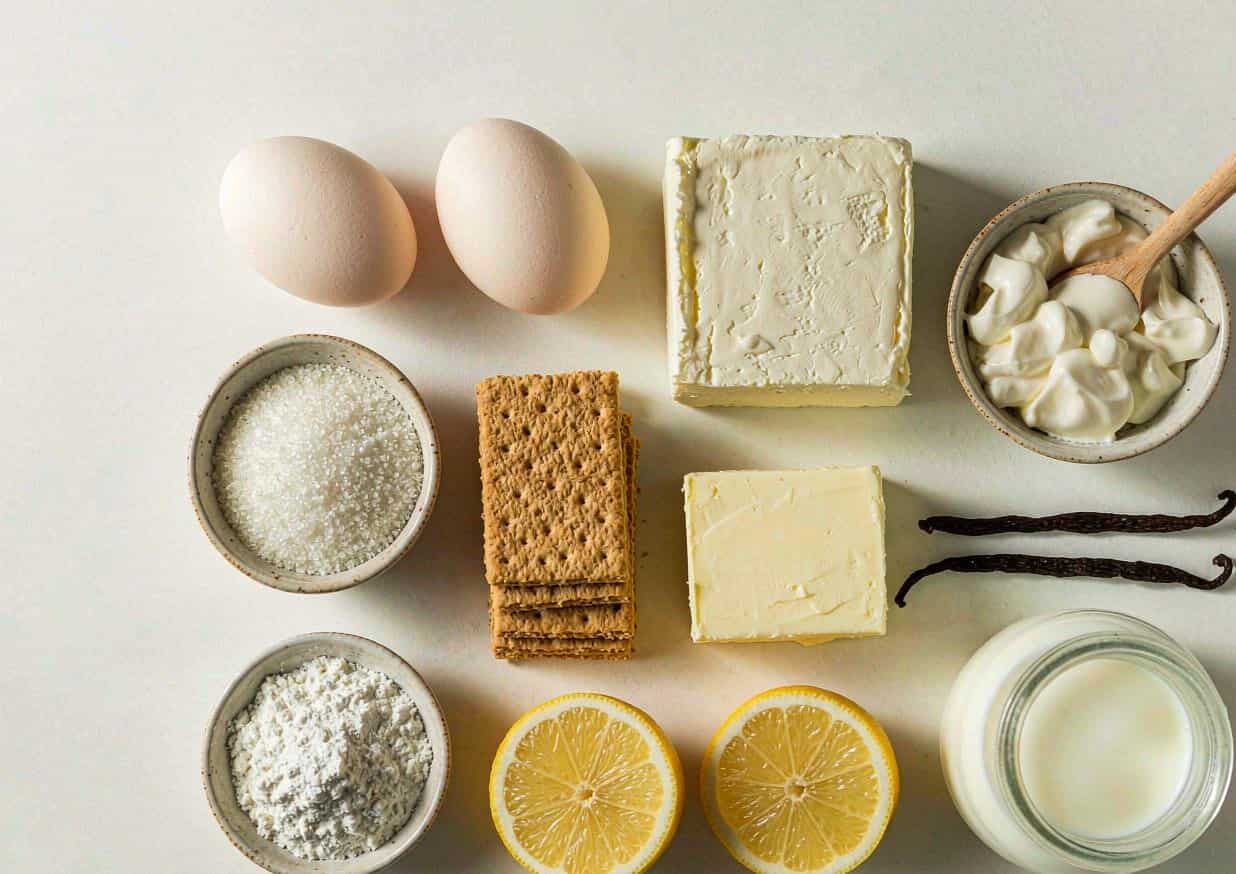
- Crust: 2 cups / 240 g graham-cracker crumbs (about 14 full sheets)
- 3 tbsp granulated sugar
- 1/2 tsp fine sea salt
- 7 tbsp / 100 g unsalted butter, melted
- Filling: 32 oz / 900 g full-fat block cream cheese, at room temperature
- 1 1/4 cups / 250 g granulated sugar
- 1/2 cup / 120 g sour cream, at room temperature
- 1 tbsp vanilla extract
- 1 tbsp lemon juice
- 1/4 tsp fine sea salt
- 4 large eggs, at room temperature
- 1 large egg yolk, at room temperature
Equipment
- 9-inch / 23 cm springform pan
- Large roasting pan (for the water bath)
- Heavy-duty aluminium foil
- Stand mixer or hand mixer
How to make new york cheesecake step by step
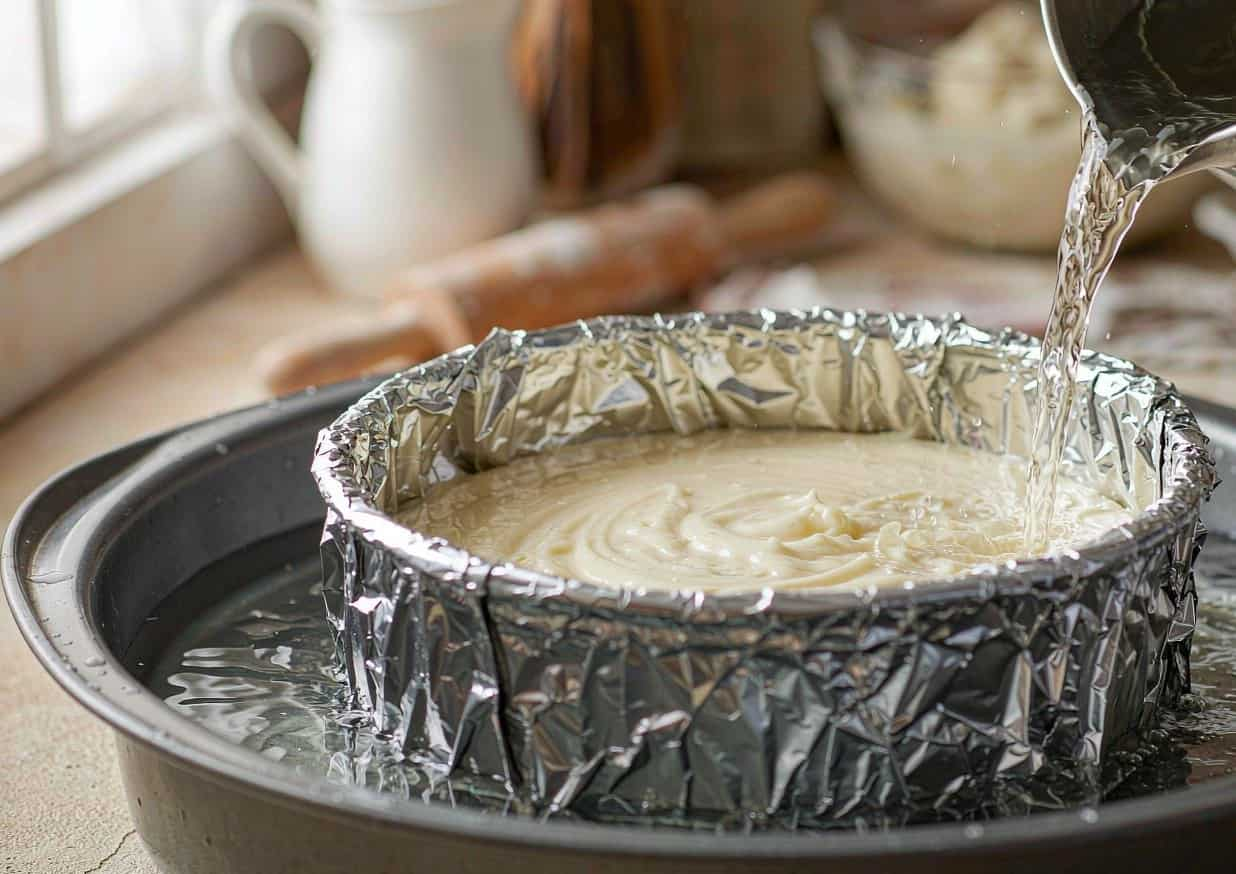
- Wrap the pan. Wrap the outside of the springform in two layers of heavy-duty foil, covering the base and up the sides. This keeps bath water out.
- Bake the crust. Heat the oven to 175°C / 350°F. Mix the crumbs, sugar, and salt, pour in the melted butter, and stir until it looks like wet sand. Press firmly into the base and 1 inch up the sides. Bake 10 minutes. Cool on a rack. Reduce the oven to 165°C / 325°F.
- Beat the cream cheese. Using the paddle attachment, beat the cream cheese on medium-low until completely smooth, about 3 minutes. Scrape the bowl halfway through. Lumps now will not disappear later.
- Add sugar and flavourings. Beat in the sugar on low for 1 minute. Add the sour cream, vanilla, lemon juice, and salt; beat until smooth.
- Add the eggs carefully. On low speed, add the whole eggs one at a time, beating only until each disappears. Add the yolk. Stop the moment it is combined — whipped-in air is the number one cause of cracks.
- Fill and tap. Pour the batter into the crust. Tap the pan firmly on the counter five times to release large air bubbles.
- Set up the water bath. Put the springform in the roasting pan and pour in hot water to reach halfway up the sides of the springform.
- Bake. Bake at 165°C / 325°F for 80 minutes. It is done when the edges are set but the centre 3 inches still wobble like set jelly when you nudge the pan.
- Cool in the oven. Switch the oven off, prop the door open with a wooden spoon, and leave the cheesecake inside for 1 hour. This gradual cool-down is the second half of crack prevention.
- Chill. Run a thin knife around the edge, cool to room temperature, then refrigerate uncovered for at least 6 hours and ideally overnight.
- Slice. Release the springform. Cut with a thin sharp knife dipped in hot water and wiped dry between cuts.
What we learned testing this new york cheesecake recipe
We cooked this recipe three times before publishing it. These are the things that only showed up in the kitchen, not on paper.
- Room-temperature ingredients are the whole game. In the batch where we used cold cream cheese, the batter stayed lumpy no matter how long we beat it, and those lumps baked into visible white flecks. We now leave the blocks out for a full two hours.
- We deliberately over-beat one batch to see what would happen: the batter nearly doubled in volume, the cake rose like a soufflé, then cracked in three places as it cooled. Stop mixing the moment the batter looks smooth and satiny.
- The water bath is not optional. The batch baked without one domed in the middle, cracked deeply, and had a dry, slightly rubbery edge about 2 cm thick. With the water bath the top stayed flat and the texture was uniform from edge to centre.
- Slow cooling prevents the crack. We switch the oven off, prop the door open with a wooden spoon, and leave the cake inside for an hour. Pulling it straight out into room air produced a hairline crack every time.
- Full-fat everything. The batch made with reduced-fat cream cheese wept liquid overnight and never fully set in the middle.
Expert tips
- Room temperature is not optional. Cold cream cheese produces a lumpy batter every time. Two hours on the counter, or submerge sealed blocks in warm water for 15 minutes.
- Use the paddle, not the whisk attachment. You want to combine, not aerate.
- If the top browns too quickly, tent it loosely with foil in the last 20 minutes.
- A hairline crack is cosmetic. Cover it with a thin layer of sour cream or a pile of berries.
Variations and substitutions
- Lemon cheesecake: add the zest of two lemons with the sour cream.
- Brown-butter crust: brown the butter before mixing it into the crumbs for a nutty, deeper crust.
- Pumpkin swirl: swirl 1 cup of pumpkin purée mixed with 1 tsp cinnamon through the batter before baking.
- Gluten-free: use gluten-free graham crackers or a crushed gluten-free cookie for the crust; the filling is naturally gluten-free.
Troubleshooting
| What went wrong | Why it happens | How to fix it |
|---|---|---|
| Crack across the top | Over-mixing, or the cake cooled too quickly. | Mix only until smooth, then cool in the switched-off oven with the door ajar for an hour. |
| Grainy or lumpy texture | The cream cheese was too cold when beaten. | Soften the blocks at room temperature for two hours and scrape the bowl down twice. |
| Centre is still liquid after baking | The oven runs cool, or the cake was underbaked. | Bake until the edge is set and a 5 cm circle in the centre still wobbles; a thermometer should read 65°C / 150°F. |
| Soggy or weeping crust | Too much butter, or the crust was not chilled before filling. | Chill the pressed crust for 30 minutes before adding the batter, and use 5 tbsp butter per 2 cups of crumbs. |
Storage, food safety and make-ahead
Covered in the fridge, cheesecake keeps for 5 days. Freeze whole or in slices, double wrapped in plastic and foil, for up to 2 months. Thaw overnight in the fridge; do not thaw at room temperature or the crust will sweat.
For safe cooling, storage times, and reheating, follow the USDA FSIS food safety guidance.
Nutrition information
Per slice (1/12 of the cake): approximately 480 kcal, 7 g protein, 34 g fat, 36 g carbohydrates, 1 g fibre, 380 mg sodium. Estimates based on USDA FoodData Central reference values.
Figures are calculated from the USDA FoodData Central database and are estimates only. Values vary with ingredient brands and portion size.
Frequently asked questions
Do I really need a water bath?
Yes. It distributes heat evenly and keeps the top from drying out and splitting. Without a roasting pan, put a large baking dish of water on the rack below the cheesecake instead.
Why did my cheesecake crack?
Almost always one of three things: the eggs were overbeaten, the cake was baked too long, or it cooled too fast. Pull it when the centre still wobbles and let it cool in the oven.
Can I use low-fat cream cheese?
We do not recommend it. Reduced-fat cream cheese has more water and less fat, which produces a grainy texture and a weepy bake. If you must, drain it in a sieve lined with cheesecloth for 2 hours first.
How far ahead can I make it?
Up to two days. The flavour and texture are actually better on the second day. Add any fruit topping just before serving so it stays fresh.
Sources and further reading
- USDA FoodData Central
- King Arthur Baking Company — Baking Resources
- Serious Eats — The Food Lab
- Epicurious — Recipe Archive & Technique Guides
Nutrition figures on this page are calculated from the USDA FoodData Central database and are estimates only. They are not a substitute for advice from a qualified dietitian or physician.
Last updated: September 5, 2026. Recipe tested three times in a standard home kitchen by the named author above. Corrections are welcome and are noted on the page when published.