 Old Kitchen Stories
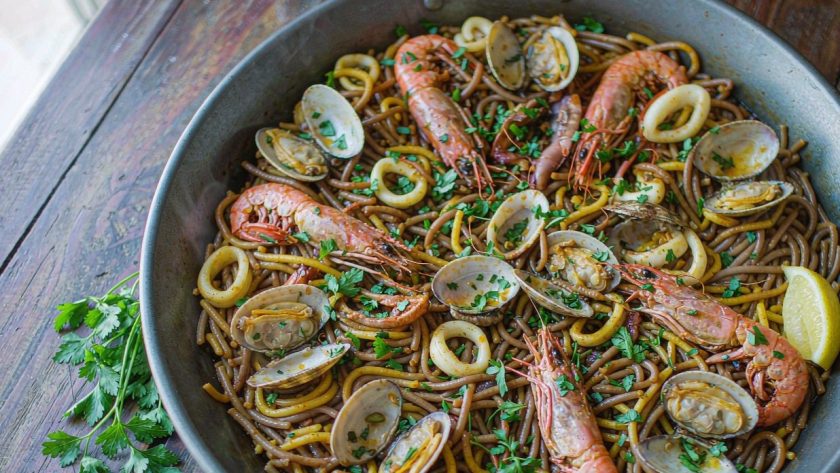
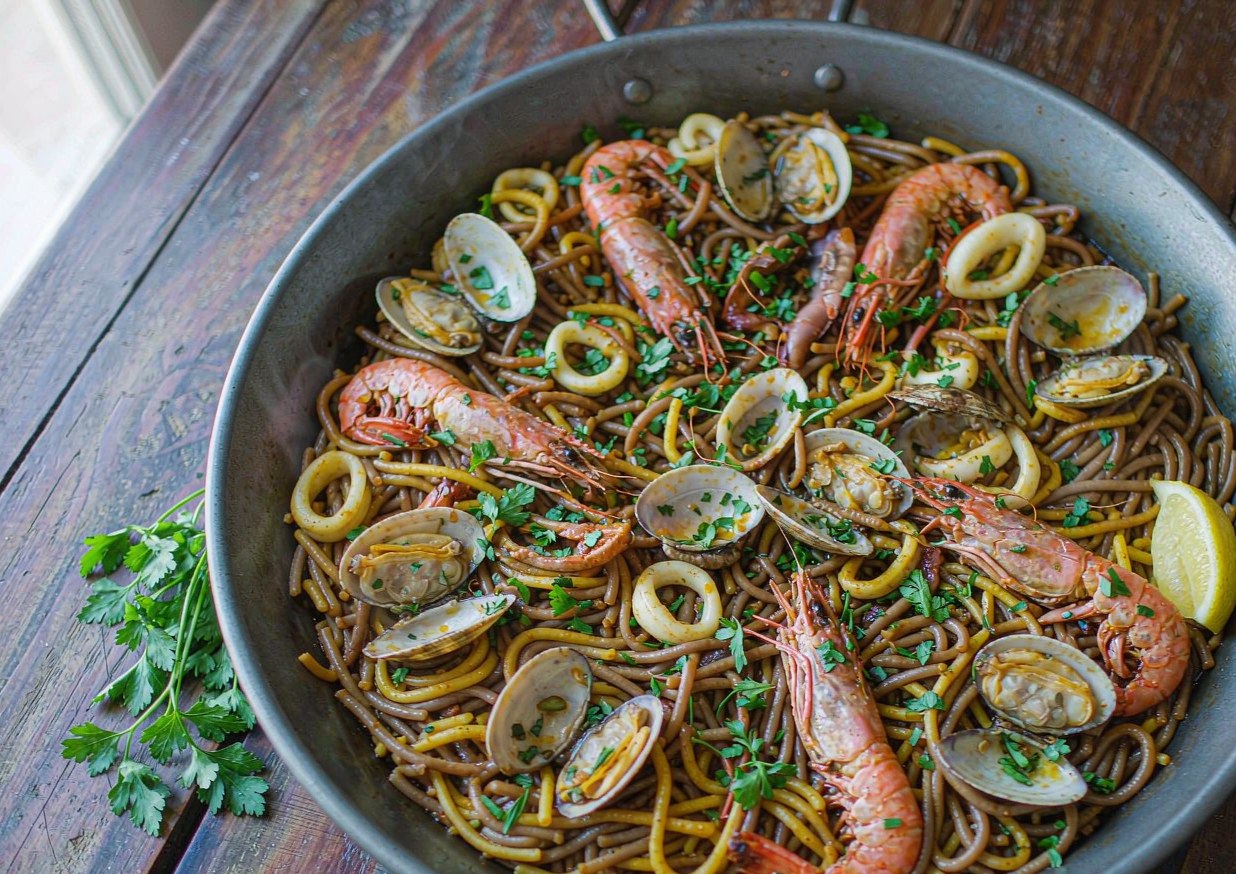
Quick answer: Soften one grated onion in 150 ml of olive oil for 8 minutes, add three grated tomatoes and cook 10 minutes more until jammy. Add three sliced garlic cloves for the last minute, push the sofrito to the rim, add 300 g of fideus, and toast for 3 minutes until they smell of toast. Off the heat stir in a teaspoon of pimenton, then pour in 750 ml of hot saffron stock, two and a half times the weight of the noodles. Season, scatter 300 g of squid rings on top, and simmer 8 minutes without stirring. Lay 12 prawns and 12 clams on the surface, cover, and cook 5 minutes until the clams open. Raise the heat for 90 seconds to set the socarrat, then rest 5 minutes.
- Prep time: 25 minutes
- Cook time: 22 minutes
- Total time: 47 minutes
- Servings: 4
- Cuisine: Spanish
- Course: Pasta & Noodles
- Difficulty: Medium
Why this recipe works
Fideua comes from Gandia on the Valencian coast, and what separates it from paella is the noodle. Fideus are short strands of wheat dried hard, and they turn to paste if you treat them like rice. So they are toasted in oil first: three minutes drives out the last moisture and sets the starch on the outside of every strand, so the noodles drink stock without dissolving into it. Second, the ratio. Rice takes about three times its volume in broth; fideus want two and a half times their weight and no more, because a fideua finishes almost dry, each strand separate. Third, the pan. A 32 to 34 cm paella pan gives a layer one noodle deep, which lets the stock reduce around the noodles rather than boil them. And you do not stir: stirring rubs starch off the strands and leaves glue. What you listen for at the end is the socarrat, as the last stock evaporates and the base crackles and toasts. Ninety seconds, and it is the point of the dish.
Our method follows the technique guidance published by Serious Eats — The Food Lab and is adapted for a standard home kitchen.
Ingredients
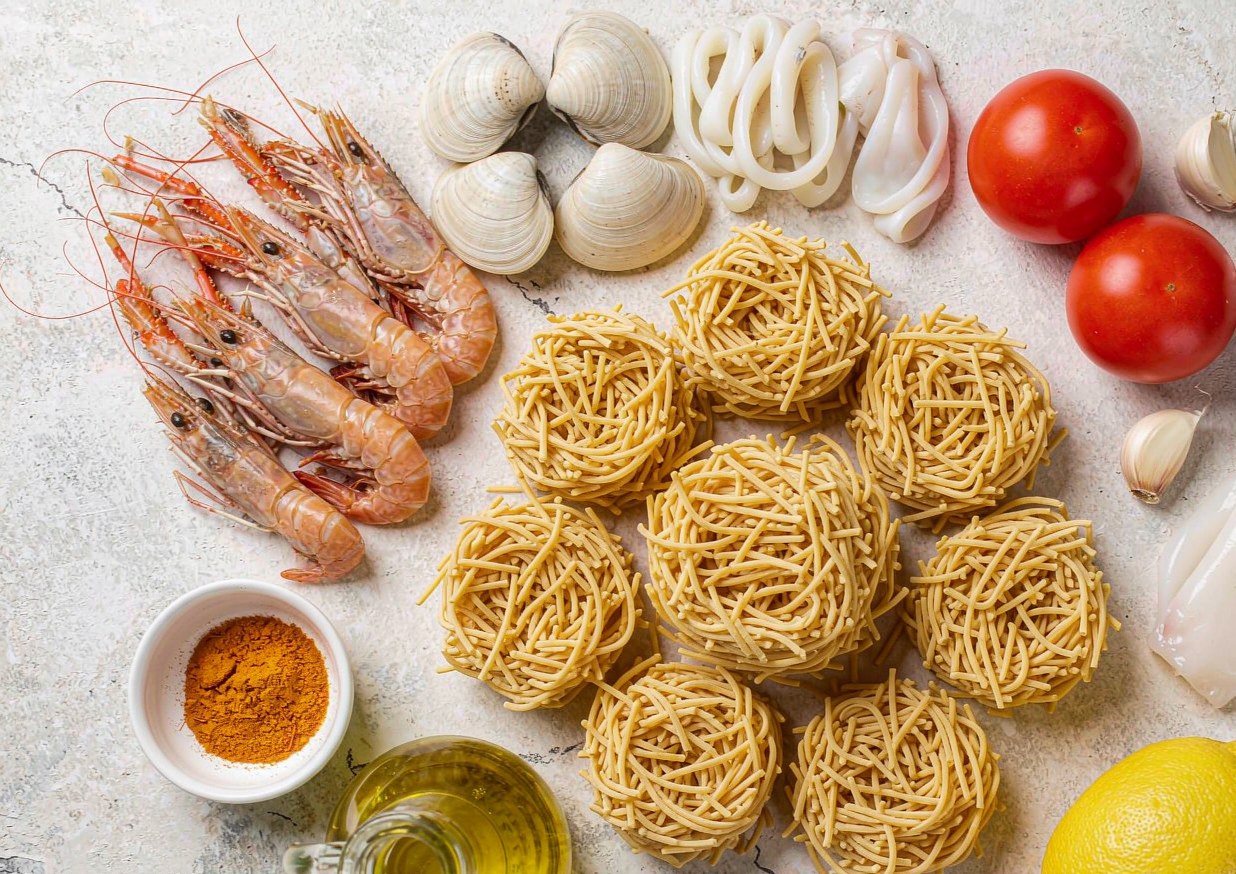
- 300 g / 10 1/2 oz fideus noodles (no. 2 or no. 3)
- 750 ml / 3 1/4 cups hot fish stock, with a large pinch of saffron steeped in it
- 1 large onion, about 200 g / 7 oz, grated
- 3 ripe tomatoes, about 350 g / 12 oz, grated, skins discarded
- 4 cloves garlic, 3 sliced and 1 kept whole for the picada
- 150 ml / 2/3 cup extra-virgin olive oil
- 1 tsp sweet pimentón (Spanish paprika)
- 300 g / 10 1/2 oz cleaned squid, bodies in rings, tentacles whole
- 12 large raw prawns, about 300 g, peeled, tails left on
- 12 clams, scrubbed and soaked in cold water for 20 minutes
- 1 tsp fine sea salt, plus more to taste
- Picada: the reserved garlic, a handful of flat-leaf parsley, 2 tbsp olive oil
- 1 lemon, in wedges, to serve
Equipment
- A 32 to 34 cm carbon steel or stainless paella pan — wide and shallow, so the noodles sit one strand deep and the stock reduces around them
- A heat diffuser if the pan is wider than your gas flame; without one the centre scorches while the rim stays raw
- A digital kitchen scale, because the stock is measured against the weight of the noodles rather than a cup
- A mortar and pestle for the picada, and a box grater for the onion and the tomatoes
- An instant-read thermometer, so the prawns come out at 60°C / 140°F
- A spider strainer, and a wide metal spatula for checking the crust on the base
How to make seafood fideuà step by step
- Bloom the saffron. Warm the stock until steaming, take it off the heat, crumble in the saffron, and leave it for 10 minutes until deep amber. Keep it hot; cold stock stalls the cook and the noodles go stodgy.
- Grate the aromatics. Grate the onion and tomatoes on the coarse side of a box grater, discarding the tomato skins. Grating gives a sofrito that melts into the oil, which is what you want under noodles this thin.
- Make the sofrito. Heat the oil in the pan over medium heat, add the onion, and cook for 8 minutes until soft. Add the tomato and cook 10 to 12 minutes more, stirring now and then, until the oil separates and the mixture darkens to brick red. Add the sliced garlic for the last minute only.
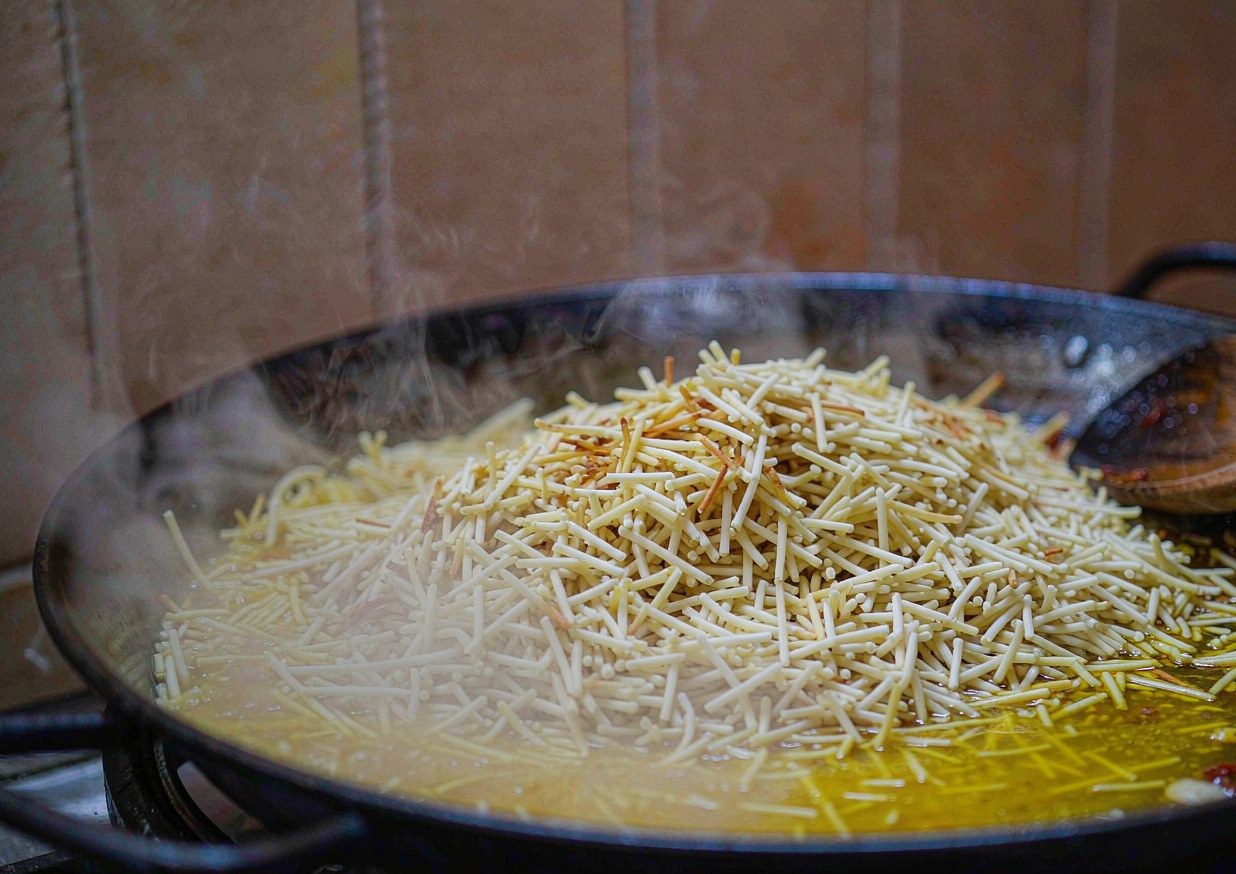
- Toast the fideus. Push the sofrito out to the rim. Add the noodles to the clear middle and toast them, stirring constantly, for about 3 minutes, until they turn light brown and smell of toast. Do not walk away: brown to bitter takes under a minute.
- Add the paprika and stock. Take the pan off the heat — pimenton burns instantly and turns bitter — stir it in, then pour in the hot stock all at once. Stir once to combine and add the salt.
- Scatter the squid. Spread the rings and tentacles over the surface and press them just under. They go in now, not at the end, because they need the full cook to turn tender; five minutes would leave them rubbery.
- Simmer without stirring. Bring it to a steady simmer over medium-high heat and cook for 8 minutes. Do not stir. If one side bubbles harder, rotate the pan a quarter turn instead of reaching for a spoon.
- Add the prawns and clams. Lay them on the surface, hinge side up, and press them in lightly. Cover and cook 5 minutes, until the clams open and the prawns read 60°C / 140°F at their thickest point. Discard any clam that stayed shut.
- Build the socarrat. Uncover, check a little liquid remains, and raise the heat to high for 60 to 90 seconds. Listen rather than watch: you want a quiet crackling and a smell of toast. Pull it the moment that smell turns sharp.
- Picada and rest. Crush the reserved garlic with the parsley and a pinch of salt, loosen with the 2 tablespoons of oil, and trickle it over the pan. Take it off the heat, drape a clean towel over it, and rest 5 minutes. Serve with lemon wedges.
What we learned testing this seafood fideuà recipe
We cooked this recipe three times before publishing it. These are the things that only showed up in the kitchen, not on paper.
- Our first pan was a genuine failure. We skipped the toasting, poured in cold stock, and then stirred it every couple of minutes out of risotto habit. Ten minutes in we had a grey, gluey mass with the strands welded together and the clams sitting on top like gravel. Toasting the fideus, hot stock, and keeping our hands off it turned the same ingredients into separate strands.
- Stock ratio, tested at 2:1, 2.5:1 and 3:1 against the weight of the noodles: at 2:1 the noodles were still firm with a chalky core, at 2.5:1 they were done as the pan went almost dry, and at 3:1 there was standing liquid at fourteen minutes and the noodles had gone soft. Two and a half is the number.
- Noodle thickness: no. 0 strands cooked through in about 5 minutes and were already collapsing by the time the clams opened. No. 3 held its shape through the full cook and gave the chewier, more traditional texture. We now buy no. 3 when we can.
- Pan size, the same recipe in a 24 cm skillet against a 34 cm paella pan: in the small pan the noodle layer was three strands deep, the outside overcooked while the middle stayed firm, and the socarrat burned before the rest was ready. Diameter is not optional.
- Socarrat by ear. At 60 seconds there was nothing, at 90 a quiet crackling and a smell of toast, and at 2 minutes 15 the smell turned acrid and the base was bitter. We now set a timer for 75 seconds and listen from there rather than guessing.
Expert tips
- Weigh the noodles and multiply by 2.5 for the stock. Cups fail here, because a cup of fideus varies with how tightly they pack.
- Hot stock, always. Cold stock drops the pan temperature and the noodles soften before the cook properly starts.
- Buy no. 2 or no. 3 fideus if you can. Thinner grades overcook inside the eight-minute simmer.
Variations and substitutions
- With cuttlefish: swap the squid for 300 g of diced cuttlefish and add four cooked artichoke hearts, quartered, with the stock.
- Fideua de pollo: brown 400 g of bone-in chicken thighs in the oil before the sofrito and use chicken stock.
- All-prawn: use 600 g of prawns, half stirred in with the stock and the rest on top for the last 4 minutes.
- No fideus: break 300 g of thin vermicelli or angel hair into 3 cm lengths and toast them the same way. The texture is a little softer.
Troubleshooting
| What went wrong | Why it happens | How to fix it |
|---|---|---|
| Noodles are gluey and stuck together | They were never toasted, or the pan was stirred during the simmer, which rubs the starch off the outside of each strand and thickens the pan into paste. | Toast the fideus for a full 3 minutes until they smell of toast, then leave them alone once the stock is in. If it has already happened, spread it on a hot tray under a broiler for 2 minutes to dry it out. |
| Noodles are hard in the middle | Not enough stock for the weight of noodles, or the heat was too high so the liquid evaporated before it could be absorbed. | Weigh the noodles and use 2.5 times that weight in stock. If the pan is dry and the noodles are still firm, add 100 ml of hot stock, cover, and give it another 3 minutes. |
| Clams are rubbery and the prawns are dry | They went in with the stock and had the full fourteen minutes instead of the five they need. | Shellfish goes on the surface for the last 5 minutes only. Discard any clam that has not opened, and pull the prawns at 60°C / 140°F. |
| The base burned before the noodles cooked | The pan was smaller than 32 cm, or there was a hot spot because the heat was too high for too long. | Use a wide shallow pan, rotate it a quarter turn instead of stirring, and use a heat diffuser on gas. If it has caught, lift the top layer off and leave the burnt base behind rather than scraping it through. |
Storage, food safety and make-ahead
Fideua is best within 20 minutes of leaving the heat and does not keep especially well, because the noodles go on drinking whatever liquid is left. Cool leftovers quickly, refrigerate in a shallow covered container for up to 2 days, and reheat in a wide covered pan over low heat with a splash of stock. Do not freeze a finished fideua, but the sofrito base freezes for up to 3 months.
For safe cooling, storage times, and reheating, follow the USDA FSIS food safety guidance.
Nutrition information
Per serving (one of four): approximately 615 kcal, 34 g protein, 33 g fat, 47 g carbohydrates, 3 g fibre, 1,180 mg sodium. Values are estimates derived from the USDA FoodData Central database and will move with how much oil the sofrito holds and how large your prawns are.
Figures are calculated from the USDA FoodData Central database and are estimates only. Values vary with ingredient brands and portion size.
Frequently asked questions
Is fideua just paella with noodles in it?
No. The noodle is toasted before any liquid goes in, which rice never is; the liquid is measured against the weight of the noodles rather than their volume; and the whole cook is about 14 minutes instead of 30, with no resting period. The socarrat is deliberately thinner and crisper than a paella crust.
What can I use if I cannot find fideus?
Thin vermicelli or angel-hair pasta broken into 3 cm lengths, weighed rather than measured. Broken spaghettini works but needs 2 more minutes. Avoid anything thicker than about 1.5 mm, which stays firm in the middle once the stock has gone.
Do I need a paella pan?
A wide stainless skillet or braising pan of the same diameter works. What matters is the diameter: you need the noodles one strand deep. In a 24 cm pan the same quantity is three strands deep and cooks unevenly.
How do I stop the noodles going mushy?
Toast them properly, use no more than 2.5 times their weight in stock, and do not stir once the stock is in. Most mushy fideua comes from stirring, which rubs starch off the strands and thickens the pan into glue.
Sources and further reading
- USDA FoodData Central
- Serious Eats — The Food Lab
- USDA FSIS — Safe Minimum Internal Temperatures
- BBC Food — Recipes & Techniques
Nutrition figures on this page are calculated from the USDA FoodData Central database and are estimates only. They are not a substitute for advice from a qualified dietitian or physician.
Last updated: September 7, 2026. Recipe tested three times in a standard home kitchen by the named author above. Corrections are welcome and are noted on the page when published.